
The best time to spray is a window of hours with no rain forecast, a light and steady wind, moderate temperature and humidity that is not too low. Avoid strong wind and gusts (spray drift), rain before the product has taken effect (wash-off), heat (droplet evaporation and risk of phytotoxicity) and dead calm, which can signal a temperature inversion. The product label always has the final say; Orcelis rates each hour of the forecast for your plot as optimal, caution or do not spray, and highlights the best window.
Orcelis’s screens are in Spanish; button and menu names are shown as they appear in the app.
Why the weather decides a treatment
A plant protection treatment only works if the product reaches the plant and stays on it for as long as needed. The weather affects the three things that matter most:
- Efficacy: if it rains shortly afterwards, the product is washed off; if it is very hot, the droplets evaporate before they arrive.
- Drift: in windy conditions, part of the spray ends up outside the plot, on neighbouring crops, watercourses or inhabited areas.
- Safety: for the operator, for the surroundings and for the crop itself (phytotoxicity in hot weather).
In Spain, Royal Decree 1311/2012 on the sustainable use of plant protection products requires them to be applied in a way that reduces risks to health and the environment. In addition, the label of each product may set its own conditions. No forecast replaces the label.
Wind: the driver of spray drift
Drift increases with wind speed, with gusts, with finer droplets and with greater boom or nozzle height. A light, steady wind is ideal. Gusts are worse than the average wind, because they carry the spray away all at once.
Dead calm is not a good sign either. On clear nights and windless dawns a temperature inversion can form: cold air stays close to the ground and fine droplets remain suspended and travel long distances. Also check the wind direction in relation to watercourses, houses or sensitive crops.
Rain: before and after spraying
Rain shortly after application can wash the product off. Each formulation has its own rainfastness, which is usually stated on the label or the technical data sheet. That is why you need to check the forecast for the following hours, not just for when you set out. With waterlogged soil, the risk of runoff also increases.
Temperature and humidity
In hot, dry air, small droplets evaporate on the way and the stressed plant takes up the product less well. In great heat the risk of phytotoxicity rises. In the cold, some products lose efficacy. Mild hours with some humidity are the safest.
The hour-by-hour criteria Orcelis uses
Orcelis takes the weather forecast for your plot’s location and rates each hour on three levels. These are general, indicative thresholds:
| Level | When it is shown |
|---|---|
| Do not spray | Average wind above 20 km/h, gusts above 30 km/h, rain forecast, probability of rain above 60%, or temperature above 30 °C or below 5 °C |
| Caution | Wind above 12 km/h, relative humidity below 35% or temperature between 28 and 30 °C |
| Optimal | None of the above conditions |
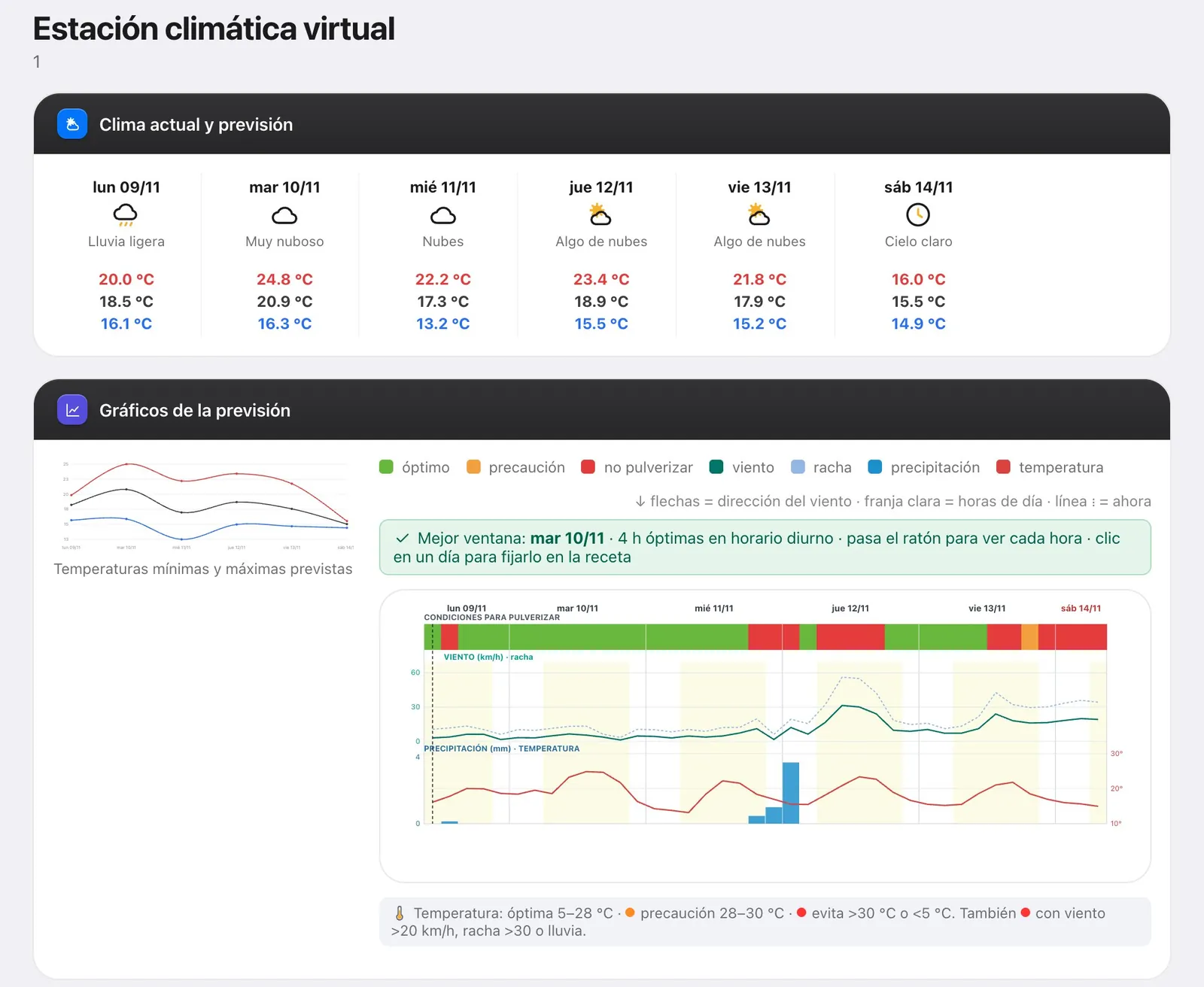
The Mejor ventana (best window) is the day with the most optimal hours during daytime (from 8:00 to 19:00).
How to see the best window in Orcelis
In the crop’s weather station
- Open the crop record and go to Acciones / Operaciones › Estación climática (Actions / Operations › Weather station).
- Under Gráficos de la previsión (forecast charts) you will see the pronóstico de pulverización (spray forecast) and, above it, the Mejor ventana line with the day and the optimal hours.
- Read the meteogram: at the top, the Condiciones para pulverizar (spraying conditions) band (green, orange and red); in the middle, wind, gusts and arrows showing direction; at the bottom, precipitation and temperature. The light strip marks daylight hours.
- Hover over the band to see the detail for each hour.
When writing the plant protection prescription
If you have selected a single crop in the plant protection prescription, click «Ver pronóstico» (view forecast) next to the date. The same forecast for the next 5 days opens and, by clicking a day, you set it as the prescription date. That way the decision on when to spray is tied to the document the adviser signs.
For this to work, the crop needs the coordinates of its plots. If Orcelis says there is no plot data, check the map in the crop record.
Quick checklist before you go out to spray
- Read the label: dose, pre-harvest interval, application conditions and rainfastness.
- Check the forecast for wind and gusts, and their direction relative to sensitive areas.
- Make sure no rain is forecast for the following hours.
- Avoid the hottest hours and very dry air.
- Check nozzles and pressure: coarser droplets drift less.
- Record the treatment in the field logbook with the actual application date.
Frequently asked questions
How windy is too windy to spray?
There is no single figure for all products and equipment. As a general rule, in strong or gusty wind drift shoots up and it is best not to spray; Orcelis shows «no pulverizar» (do not spray) above 20 km/h average wind or 30 km/h gusts. Always check what the label says.
How long without rain does a treatment need?
It depends on the product: each one has its own rainfastness, which is usually stated on the label or the technical data sheet. That is why it pays to check the forecast for the hours after the treatment, not just for when you apply it.
Is it better to spray in the morning or the evening?
What matters is the conditions, not the time of day: light wind, no rain, no intense heat and enough humidity. Avoid the middle of the day on hot days and dead-calm situations, which can favour a temperature inversion.