
A fertiliser plan by growth stage splits the season’s nutrient requirements across the crop’s stages (for example, bud break, flowering and fruit set, fruit sizing and post-harvest) according to what the crop takes up in each one. It is done in four steps: calculate the fertiliser units (UF, kg of nutrient) per hectare for the expected yield, subtract what the soil, the water and the base dressing already supply, assign a percentage of each nutrient to each stage and choose the fertiliser used to apply it.
Orcelis’s screens are in Spanish; button and menu names are shown as they appear in the app.
What a fertiliser plan by growth stage is
A fertiliser plan (fertilisation plan) is the planning of nutrient applications: which nutrients you supply, how much and when, matched to the crop’s real needs and to the characteristics of the soil. Doing it by growth stage means not splitting the fertiliser into equal parts, but concentrating each nutrient in the stages when the crop takes it up the most.
Done properly, it avoids applying (and paying for) fertiliser the crop doesn’t need and reduces leaching losses, because the nutrient arrives when the roots can use it.
Why split fertiliser by growth stage
Each nutrient has its moment. In general terms:
| Stage | What happens in the crop | Most important nutrients |
|---|---|---|
| Bud break and vegetative growth | New leaves and shoots | Nitrogen |
| Flowering and fruit set | Flower and fruit formation | Nitrogen, phosphorus and calcium |
| Fruit sizing | Fruit growth | Potassium, with moderate nitrogen |
| Ripening | Quality, colour and sugars | Potassium; less nitrogen |
| Post-harvest (woody crops) | Reserves for the next season | Moderate nitrogen and phosphorus |
The exact percentages depend on the species, variety, rootstock and climate. Take them from technical references for your crop and adjust them with leaf analyses and each season’s actual yield.
How to calculate the season’s fertiliser units
- Requirements: the UF/ha the crop removes for the yield you expect (bigger harvests remove more).
- Efficiency: part of the fertiliser is lost through leaching or retained in the soil, so slightly more is applied than is removed.
- Deductions: subtract what the soil already supplies according to its analysis, the irrigation water if it carries nutrients, the base dressing and organic matter.
- Split: assign each stage a percentage of each nutrient. Each nutrient must add up to 100% of what you are going to apply.
- Product: choose the fertiliser and convert UF into kg using its nutrient content: kg of fertiliser = UF ÷ content (%) × 100.
The mandatory fertilisation plan under Spanish law
In Spain the fertilisation plan has been mandatory since 1 September 2026, when the sustainable nutrition rules came into force. For irrigated production units whose crop is sown or planted between 1 March and 30 June 2026, the plan had to be in place as early as 1 January 2026.
Under Spanish law the plan must include, at least:
- Identification of the plots and crops.
- The crop’s nutrient requirements.
- Planned and actual applications.
- Available analyses (soil, water) where applicable.
A plan by growth stage covers that content and is also the one that helps you fertilise better. Generic tables calculate for an average farm; what is useful is to calculate on your actual cropped area and your own analyses.
How to do it with Orcelis
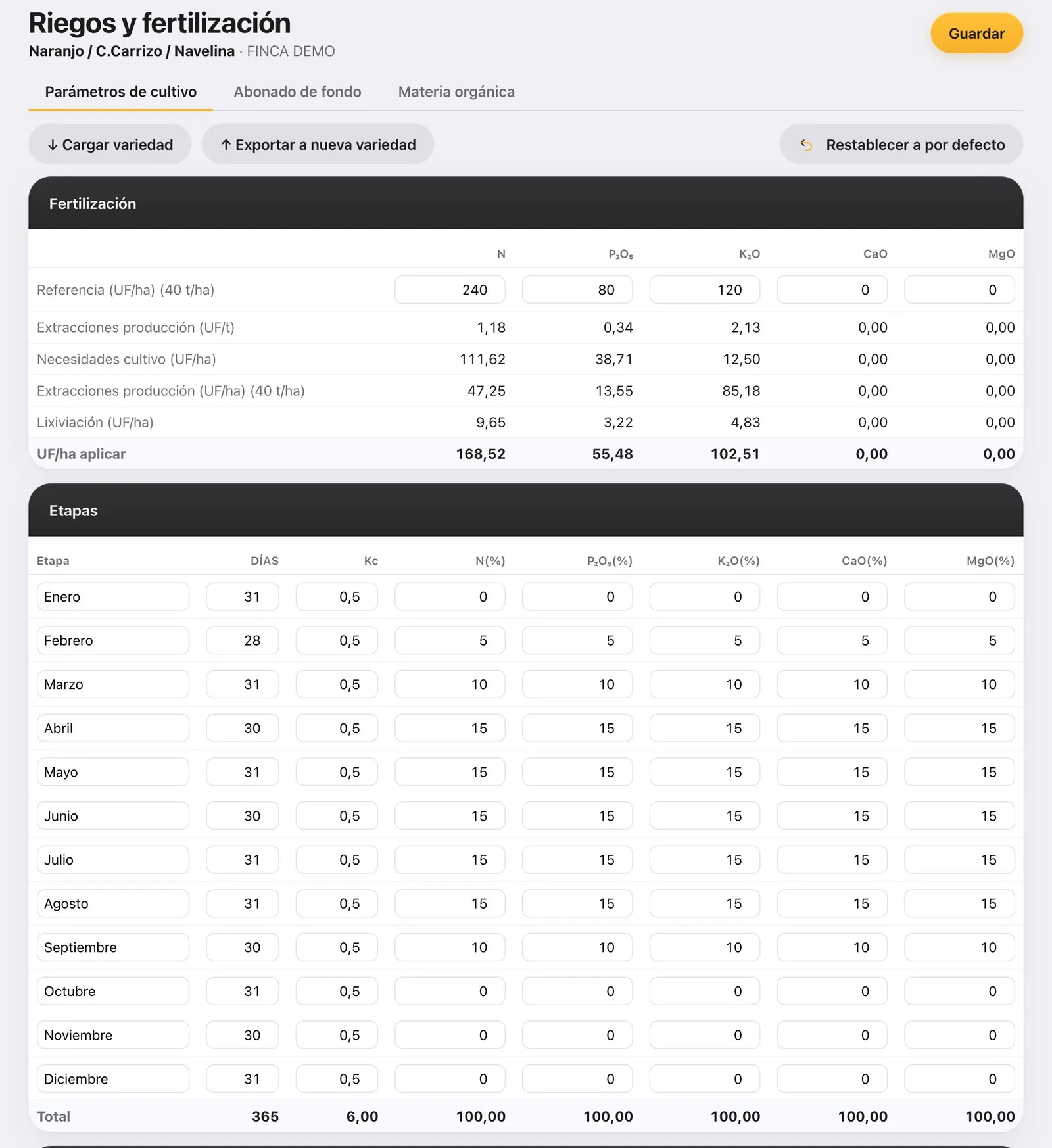
In Orcelis, each crop starts with its variety’s indices: the reference UF/ha and their split by stage, with the days and Kc of each one. You adjust them for that crop only, choose the products for each stage in the Plan de fertilizantes (fertiliser plan) and the fertigation calculation turns everything into doses per period.
Step by step
- Set the reference fertiliser units. In the crop record, go to Datos del cultivo › Riegos y fertilización › «Ver más» (Crop data › Irrigation and fertilisation › See more). In the Parámetros de cultivo tab, adjust the Referencia (UF/ha) row for N, P₂O₅, K₂O, CaO and MgO.
- Define the stages and their split. In the Etapas table, check each stage’s name, the DÍAS (days) it lasts, the Kc and the % of each nutrient. Check the Total row and click «Guardar» (Save).
- Record the base dressing and organic matter. In the Abonado de fondo (base dressing) and Materia orgánica (organic matter) tabs, enter the nutrient content and the kg/ha applied, click «Calcular» to get the UF/ha and then «Guardar».
- Link the analyses. Link the soil and leaf analyses in Datos del cultivo, and assign the water source, so that the calculation takes into account what is already there.
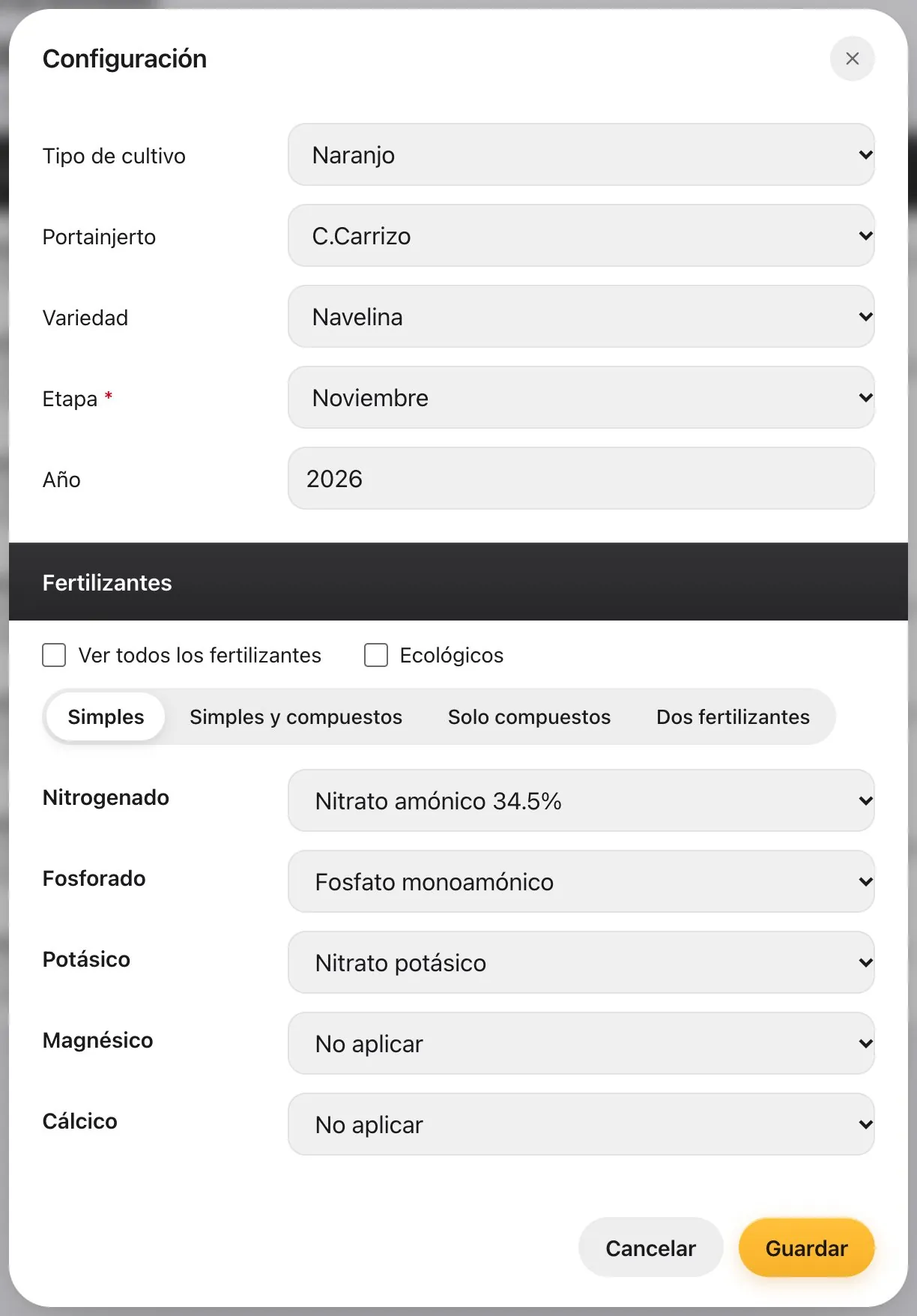
- Choose the fertilisers for each stage. In Fertirrigación › Plan de fertilizantes, click «Nueva configuración» (new configuration), choose the crop type, variety and Etapa (stage), the strategy and the products, and click «Guardar».
- Calculate and save. In Calcular fertirrigación, tick «Usar el plan de fertilizantes de cada cultivo» (use each crop’s fertiliser plan), click «Calcular fertirrigación» and save the prescriptions so they go to the schedule and the field logbook.
If you have fine-tuned a split you want to reuse, click «↑ Exportar a nueva variedad» (export to new variety) in Parámetros de cultivo. Orcelis creates your own variety that you can load into other crops with «↓ Cargar variedad» (load variety).
Common mistakes
- The percentages don’t add up as expected: check the Total row of the Etapas table before saving.
- I loaded a variety and it didn’t stick: loading does not save; click «Guardar» afterwards.
- A fertiliser plan configuration is not being applied: check that its Año (year) matches the season, or leave it blank.
- I changed the crop’s variety and lost my split: when you change the variety, the indices revert to those of the new variety.
Frequently asked questions
What is a fertiliser unit (UF)?
A fertiliser unit is 1 kg of nutrient expressed as N, P₂O₅, K₂O, CaO or MgO. So 100 UF/ha of N is 100 kg of nitrogen per hectare, regardless of the fertiliser used to apply it.
Is a fertilisation plan the same as a fertiliser plan?
Not quite. The fertilisation plan sets how many nutrients the crop needs and how they are split across stages. In Orcelis, the fertiliser plan (Plan de fertilizantes) is the part that decides which products are used to apply them at each stage.
How often should the plan be reviewed?
At least every season, and whenever the expected yield changes or you have new soil, leaf or water analyses. The previous season’s leaf analyses are a good guide for adjusting the split.