
An irrigation water analysis is read through three key values. EC (electrical conductivity) measures salinity: below 0.7 dS/m there is no restriction on use and above 3 dS/m the restriction is severe, according to the FAO. SAR measures the risk of sodium damaging soil structure and must always be read together with EC. Bicarbonates indicate a risk of lime precipitates that clog drippers, and they are corrected by acidifying the water.
Orcelis’s screens are in Spanish; button and menu names are shown as they appear in the app.
What an irrigation water analysis measures
| Parameter | Usual unit | What it tells you |
|---|---|---|
| pH | — | Acidity or alkalinity; at high pH, carbonates precipitate |
| EC (electrical conductivity) | dS/m or µS/cm | Total salinity of the water |
| Calcium, magnesium, sodium, potassium | meq/l or mg/l | Cations; used to calculate SAR |
| Chlorides, sulphates, bicarbonates, carbonates, nitrates | meq/l or mg/l | Anions; toxicity, clogging and nutrients supplied by the water |
| Boron | mg/l | Toxicity in sensitive crops |
| Iron and manganese | mg/l | Dripper clogging |
To convert mg/l to meq/l, divide by the equivalent weight of the ion: for example, 61 for bicarbonate, 20 for calcium and 23 for sodium.
EC: water salinity
Electrical conductivity (EC) measures the total amount of dissolved salts. The higher it is, the harder it is for roots to take up water and the more salts build up in the wetted bulb. The FAO guidelines (Ayers and Westcot, 1985) classify it as follows:
| Water EC (dS/m) | Degree of restriction on use (salinity) |
|---|---|
| Less than 0.7 | None |
| 0.7 to 3.0 | Slight to moderate |
| More than 3.0 | Severe |
With saline water you need to irrigate with a leaching fraction: extra water that flushes salts out of the root zone. Tolerance varies widely between crops, so interpret EC with the crop you are irrigating in mind.
SAR: the sodium hazard
SAR (sodium adsorption ratio) measures the proportion of sodium relative to calcium and magnesium: SAR = Na ÷ √((Ca + Mg) ÷ 2), in meq/l. A high SAR means sodium displaces calcium in the soil, which then disperses, forms a crust and no longer lets water infiltrate properly.
SAR is never read on its own: water with a moderate SAR and very little salt (low EC) can cause more infiltration problems than water with the same SAR and higher salinity. The FAO tables cross-reference both values. In surface irrigation, sodium can also be toxic to sensitive crops from a SAR of 3, and the risk is severe above 9.
Bicarbonates: clogging and pH
Bicarbonates (HCO₃⁻) are the most common cause of clogging in drip and micro-irrigation: with high pH and calcium in the water they precipitate as calcium carbonate in drippers and filters. They also raise the pH of the soil solution and can block iron uptake.
- How they are corrected: by injecting acid at the irrigation head to lower the pH and neutralise part of the bicarbonates.
- Watch the fertiliser plan: nitric acid supplies nitrogen and phosphoric acid supplies phosphorus. Subtract those units from the fertilisation plan.
- Iron and manganese: they also cause clogging, in this case through precipitates and bacteria.
Other values worth checking
- Chlorides: toxic to sensitive crops, especially woody crops and citrus; with sprinkler irrigation they damage leaves at lower concentrations.
- Boron: needed in small amounts, but toxic at relatively low concentrations in sensitive crops.
- Nitrates, potassium, calcium and magnesium: these are nutrients. What the water brings counts towards the fertiliser plan.
- Ionic balance: the sum of cations and the sum of anions in meq/l should be similar; if not, check the analysis.
How to interpret it with Orcelis
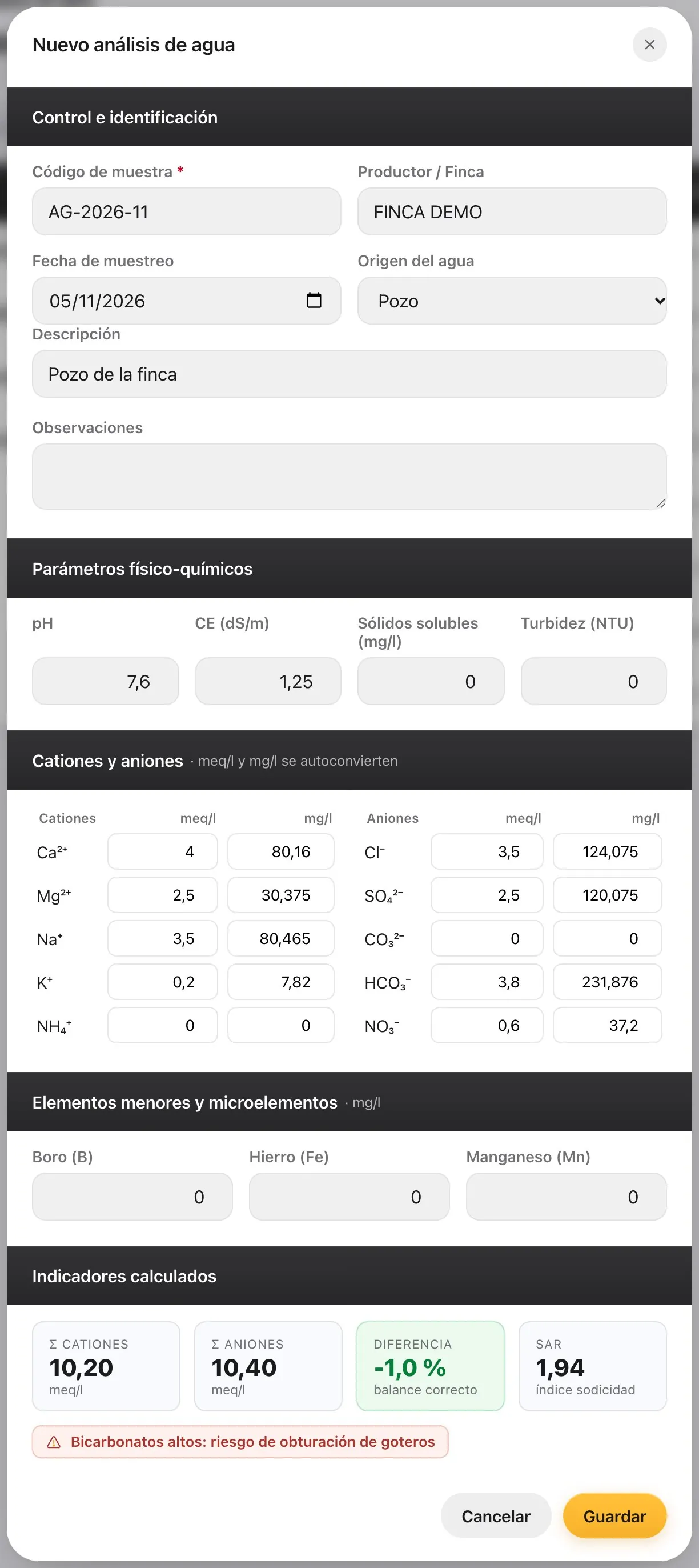
In Orcelis you record the analysis under Analíticas › Agua (Analyses › Water) with «Nuevo análisis» (New analysis). You enter cations and anions in meq/l or mg/l (the other unit is converted automatically) and the window shows the Indicadores calculados (calculated indicators): sum of cations, sum of anions, their difference and the SAR. If any value is a concern, a warning appears: high salinity, high SAR, high bicarbonates with a risk of dripper clogging, chlorides, boron, iron or manganese.
You then link the analysis to the water source (the irrigation community, the well or the reservoir) under Recursos › Procedencia del agua (Resources › Water source), and assign that source to each crop. That way, in the fertigation calculation Orcelis takes into account the EC and the nutrients the water already carries for every crop irrigated with it.
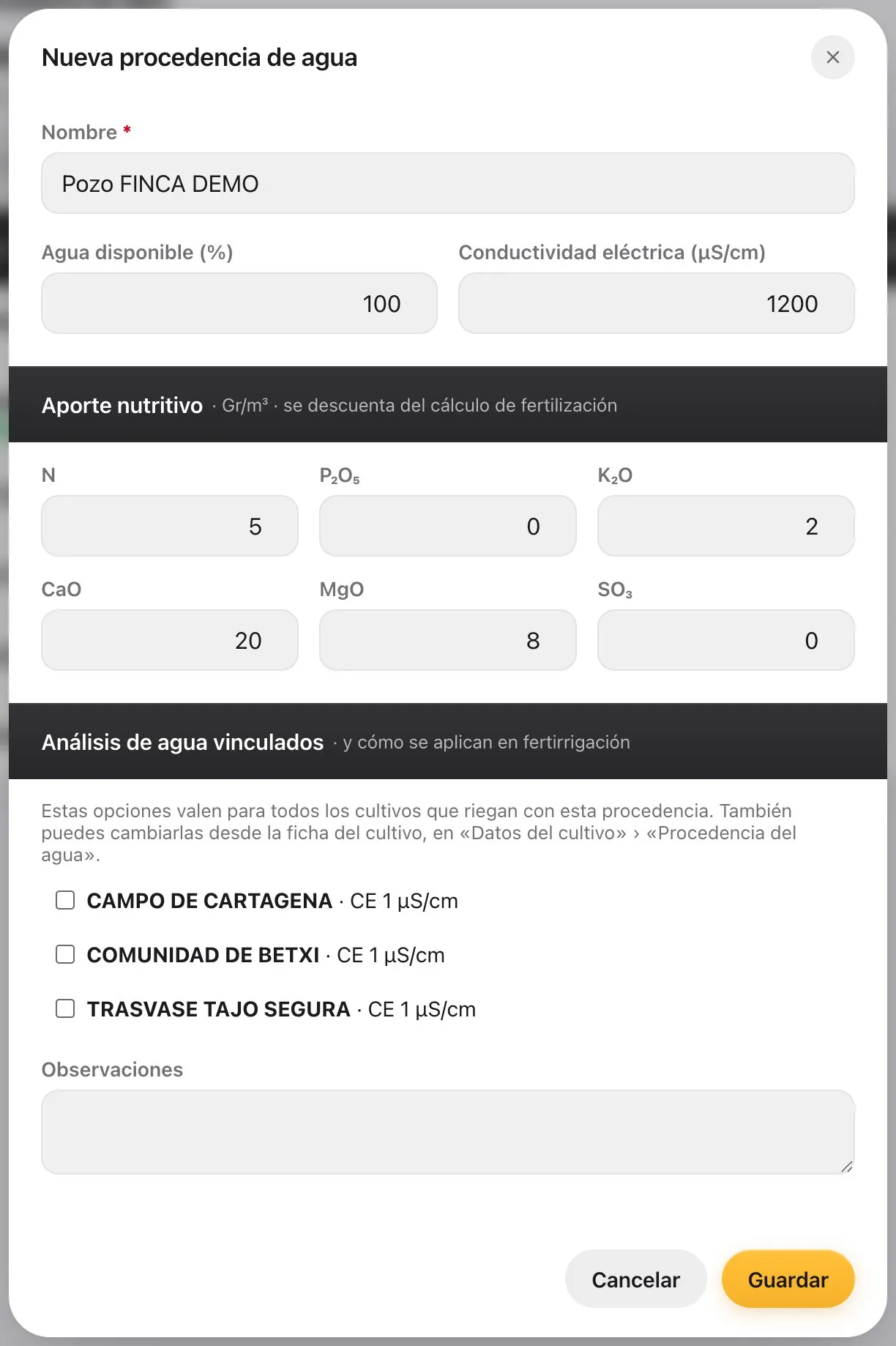
Mind the units: in the analysis, EC is entered in dS/m, and in the water source, in µS/cm (1 dS/m = 1,000 µS/cm).
Frequently asked questions
What EC is good for irrigation water?
According to the FAO guidelines (Ayers and Westcot, 1985), with an EC below 0.7 dS/m there is no restriction on use; between 0.7 and 3 dS/m the restriction is slight to moderate, and above 3 dS/m it is severe. What each crop tolerates varies greatly between species.
How do you convert µS/cm to dS/m?
1 dS/m equals 1 mS/cm and 1,000 µS/cm. Water at 1,500 µS/cm therefore has an EC of 1.5 dS/m.
How is SAR calculated?
SAR (sodium adsorption ratio) is Na ÷ √((Ca + Mg) ÷ 2), with all three concentrations in meq/l. The more sodium relative to calcium and magnesium, the higher the SAR.
Is a high SAR always a problem?
Not always: the infiltration risk depends on SAR and EC together. The same SAR is more dangerous in low-salinity water than in more saline water, because salts help keep the soil flocculated.
Why do bicarbonates clog drippers?
With high pH and calcium in the water, bicarbonates precipitate as calcium carbonate in drippers and pipes. The usual correction is to inject acid to lower the pH and neutralise part of the bicarbonates.
Does the acid used to correct bicarbonates supply nutrients?
Yes. Nitric acid supplies nitrogen and phosphoric acid supplies phosphorus. Those units must be subtracted from the fertiliser plan to avoid over-applying.
How do I know if the analysis is reliable?
Compare the sum of cations with the sum of anions, both in meq/l. If the difference is small (up to 5%), the ionic balance is correct; if it is large, ask the laboratory for clarification.
How often should irrigation water be analysed?
At least once per season, and whenever you change water source. In wells and reservoirs, quality can vary over the year, especially in summer.