
In citrus you treat when sampling shows that the pest has exceeded its action threshold, not when you see the first individuals. The threshold is almost always expressed as a percentage of infested organs (shoots, leaves or fruit) in a fixed sample, or as catches per trap. The figures depend on the pest, the variety, the area and the destination of the fruit: take them from the integrated pest management guide for citrus or from your local pest warning service. Orcelis lets you set thresholds pest by pest, as a percentage or as an absolute value.
Orcelis’s screens are in Spanish; button and menu names are shown as they appear in the app.
The principle: sample before you treat
Integrated pest management has been mandatory in the European Union since Directive 2009/128/EC, implemented in Spain by Royal Decree 1311/2012. Its principles can be summed up as:
- Prevent through good growing practice: balanced irrigation and fertilisation, pruning that opens up the canopy, healthy plant material.
- Monitor pests with suitable methods and tools: sampling and traps.
- Decide using thresholds: intervene only when the pest exceeds them.
- Prefer biological, physical and non-chemical methods when they give satisfactory control.
- Choose the most selective product with the fewest side effects on health, beneficial organisms and the environment, at the dose needed.
- Avoid resistance by rotating modes of action, and check afterwards whether the treatment worked.
In citrus this is especially important: many pests have effective natural enemies, and an unnecessary treatment can upset that balance and trigger outbreaks of other pests, such as mites.
How to sample in citrus
Each pest is sampled on the organ where it lives or causes damage, and at the crop stage when there is a risk:
| What is checked | Typical pests | How it is expressed |
|---|---|---|
| Young shoots | Aphids, citrus leafminer | % of infested shoots |
| Leaves | Mites (citrus red mite, two-spotted spider mite), whitefly | % of infested leaves, or individuals per leaf |
| Fruit | Armoured scales, citrus mealybug, thrips | % of fruit with presence or damage |
| Flower buds | Citrus flower moth | % of affected buds |
| Traps | Mediterranean fruit fly (Ceratitis capitata) | Catches per trap per day |
Rules that apply to all pests:
- Choose trees at random and spread across the whole plot, not just those at the edge.
- Always check the same number of organs of the same type, so that counts are comparable.
- Record each organ as infested or not infested: it is quicker and more reliable than counting individuals.
- Also note the beneficial organisms and the crop’s growth stage.
- Calculate the percentage: infested organs ÷ organs checked × 100. If you check 100 shoots and 18 have aphids, infestation is 18%.
Where threshold figures come from
There is no single threshold that applies everywhere. It changes with the pest, the species and the variety (a clementine and a lemon tree don’t react in the same way), the area, the time of year and the destination of the fruit: fruit for the fresh and export market is not the same as fruit for processing. That is why this guide does not give fixed figures.
In Spain, the references are the Spanish Ministry of Agriculture’s integrated pest management guide for citrus, each autonomous community’s integrated production regulations and the bulletins of the pest warning services. If you follow a customer or certification protocol, it may be stricter. Outside Spain, use the official guidance for your own country.
How to set it up with Orcelis
In Orcelis, thresholds are under Configuración › Umbrales de plagas (Settings › Pest thresholds). You choose the crop (for example, Cítricos, citrus) and, in the Plagas y umbrales (pests and thresholds) tab, each row is a pest or disease with its Nombre científico (scientific name), Qué se cuenta (what is counted), the Medida (measure: % or absoluto, absolute), the Unidad (unit), the Muestra (sample) and two limits: Ámbar desde (amber from) and Rojo desde (red from).
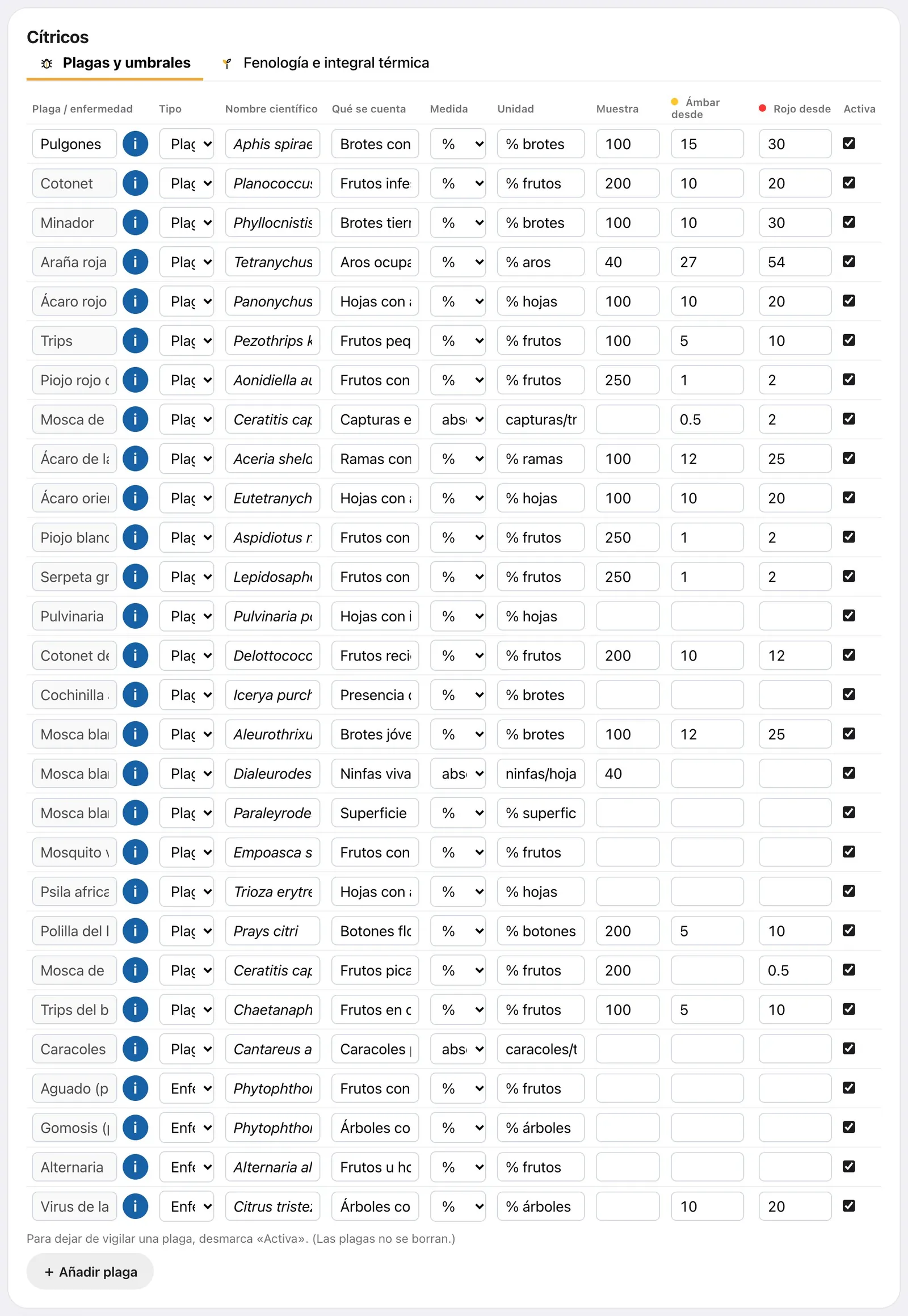
Orcelis comes with indicative default values, but the ones you save are your team’s and replace the defaults only for the pests you change. You can add pests with «+ Añadir plaga» (add pest) or switch off the ones you don’t monitor.
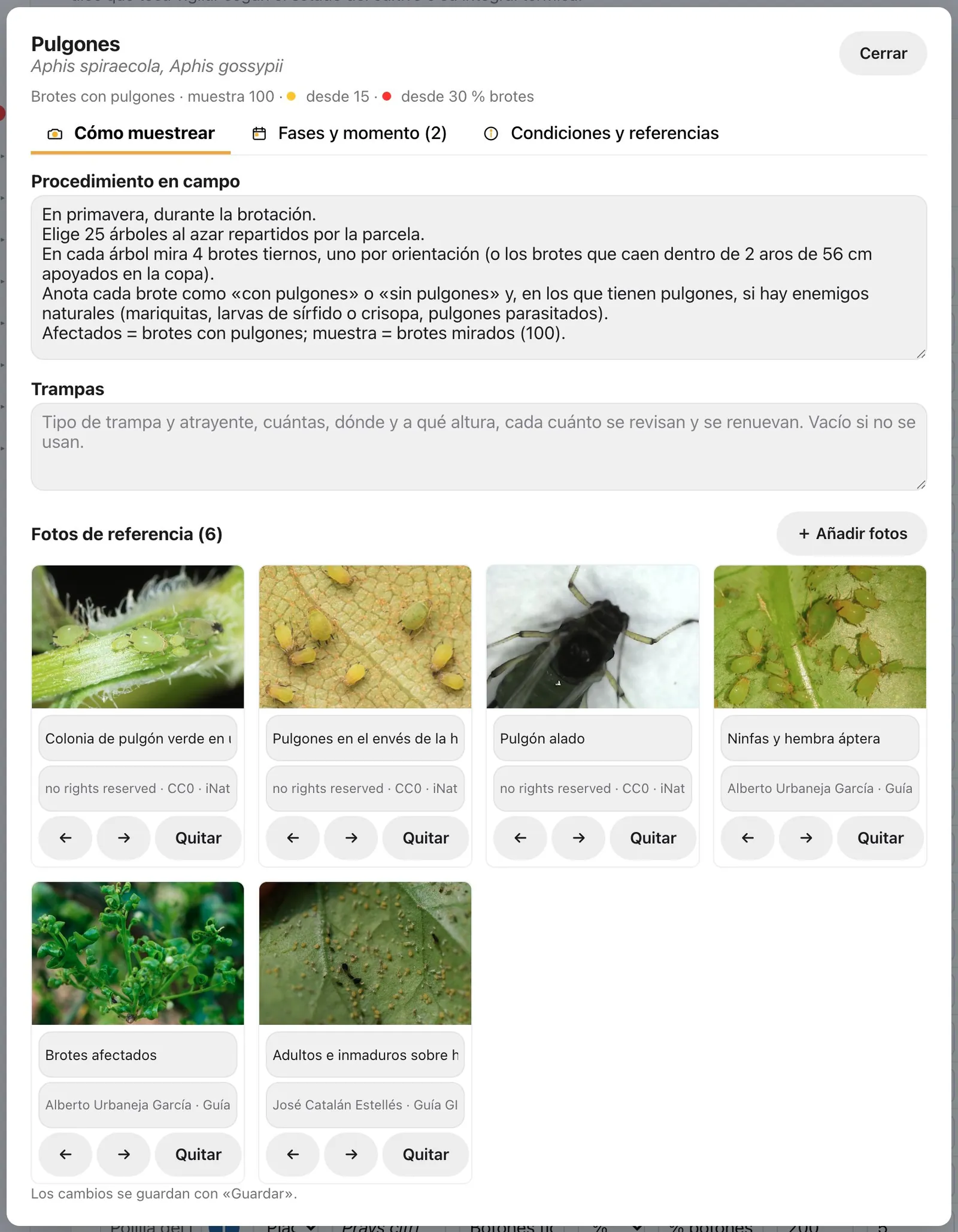
With each pest’s «i» you write the Procedimiento en campo (field procedure), the Trampas (traps) used, the Fotos de referencia (reference photos) and the Referencias consultadas (references consulted). In the field, the technician counts the pest during the visit and the app shows a green, amber or red traffic light. If it is red, they can write the prescription there and then, with the count as justification.
Frequently asked questions
What is an action threshold?
It is the level of pest population, or of damage, above which treating pays off because the expected losses exceed the cost and the side effects of the treatment. Below that level, the right thing to do is keep monitoring and let beneficial organisms do their work.
Where can I find the official citrus thresholds for Spain?
In the integrated pest management guide for citrus published by the Spanish Ministry of Agriculture, Fisheries and Food, in each autonomous community’s integrated production regulations and in the bulletins of the pest warning services. Always use the reference that applies to your area and your production system.
How many trees should be sampled?
It depends on the pest and the protocol you follow, but the rule is the same: a fixed number of trees chosen at random and spread across the whole plot, and always the same organs. For example, the aphid protocol included in Orcelis checks 4 young shoots on 25 trees, 100 shoots in total.
Threshold as a percentage or as an absolute value?
A percentage is used when you count infested organs in a sample (shoots with aphids, leaves with mites, fruit with scale). An absolute value is used when you count individuals or catches, as in fruit fly traps. The right approach is to set the measure pest by pest.
Should beneficial organisms be taken into account?
Yes. Ladybirds, lacewings, hoverflies, predatory mites or parasitoids can control the pest without treatment. Note their presence when sampling: with plenty of active beneficials, the decision may be to wait even if the count is close to the threshold.
How often should you sample?
Regularly, and more often during each pest’s risk periods, which are usually linked to flushing, flowering, fruit set or fruit colour change. Your local guide and the pest warning services mark those moments.
How do I set thresholds in Orcelis?
In Configuración › Umbrales de plagas you choose the crop and, for each pest, what is counted, the measure, the sample and the Ámbar desde and Rojo desde values. What you save applies to your whole team and is what the technician app uses to show the traffic light.