
The digital farm logbook (in Spain, the «cuaderno digital de explotación agrícola») is the electronic record of what you do on your holding: plant protection treatments, fertiliser applications, irrigation, field operations and harvests. In Spain it is governed by Royal Decree 1054/2022, within the SIEX system, and it becomes mandatory in phases between 2026 and 2028 depending on the type of record and the size of the holding. Keeping it simply means recording each operation shortly after carrying it out in an application that stores the data in the official format.
Orcelis’s screens are in Spanish; button and menu names are shown as they appear in the app.
What the digital farm logbook is
The field logbook (or farm logbook) is the history of the farm. It records what was applied, where, when and in what quantity. For years it was kept on paper. The digital version stores the same data electronically, which means it can be reviewed, totalled and shown to an inspector without reconstructing anything by hand.
In Spain, the digital logbook is part of SIEX (Sistema de Información de Explotaciones agrícolas y ganaderas y de la producción agraria, the Spanish national information system for farm holdings and agricultural production), which brings together the data of every holding. The autonomous communities (Spain’s regional governments) manage the register of holdings and receive the logbooks.
What goes into the logbook
- Plant protection treatments: product, registration number, dose, crop, plot, date and applicator.
- Fertilisation: every application of fertiliser, manure or slurry, with its quantity and date.
- Irrigation: the water applied to each crop, useful to justify fertilisation under irrigation.
- Field operations and harvests: cultivation operations and yield obtained.
- Holding details: holder, SIGPAC parcels and enclosures (Spain’s Land Parcel Identification System), crops and production system.
Who must keep it and from when (Spain)
Under Spanish law the timetable is phased. These are the key dates:
| Date | What comes into force |
|---|---|
| 1 January 2026 | Recording of nutrient applications: each fertiliser application must be recorded within one month at most. During 2026, paper or digital are both accepted. |
| 1 September 2026 | Mandatory fertilisation plan (for irrigated crops sown or planted between 1 March and 30 June 2026, already from 1 January 2026). |
| 1 January 2027 | Electronic recording of plant protection treatments. |
| 1 January 2028 | Full digital logbook for holdings above the size thresholds. |
The 2028 thresholds are: more than 30 ha of total area (rainfed and irrigated combined), more than 5 ha of irrigated land or more than 0.1 ha of greenhouse. Exceeding any one of the three is enough. You can check your case with the SIEX Checker.
Failing to keep the record up to date can mean losing between 3% and 100% of your CAP (Common Agricultural Policy) payments. The rules have been amended several times: always confirm the details with your autonomous community.
How to keep it up to date without the hassle
- Record it at the time. Reconstructing weeks of treatments from memory is the most common source of errors.
- Record what was actually applied, not what was planned. If an irrigation or a treatment didn’t happen, it should not appear as done.
- Keep the holding details complete: holder, registration code and SIGPAC enclosures for each crop.
- Let whoever applies it record it. If the grower confirms on their phone what they have done, the technician doesn’t have to guess.
How to keep it with Orcelis
In Orcelis, the logbook fills itself in from each crop’s agenda (schedule). Whatever you save from the fertigation calculation and from the plant protection prescription goes into the schedule without retyping it. To record something by hand (a field operation, a harvest), click «+ Registrar» (Record) in the crop’s Cuaderno (logbook) tab.
The grower confirms on their phone app what they have done: «Hecho» (done), «Cambió algo» (something changed) or «No se pudo» (couldn’t be done). That way the Orcelis logbook records what was actually applied: tasks marked No aplicado (not applied) and those for days still to come are left out.
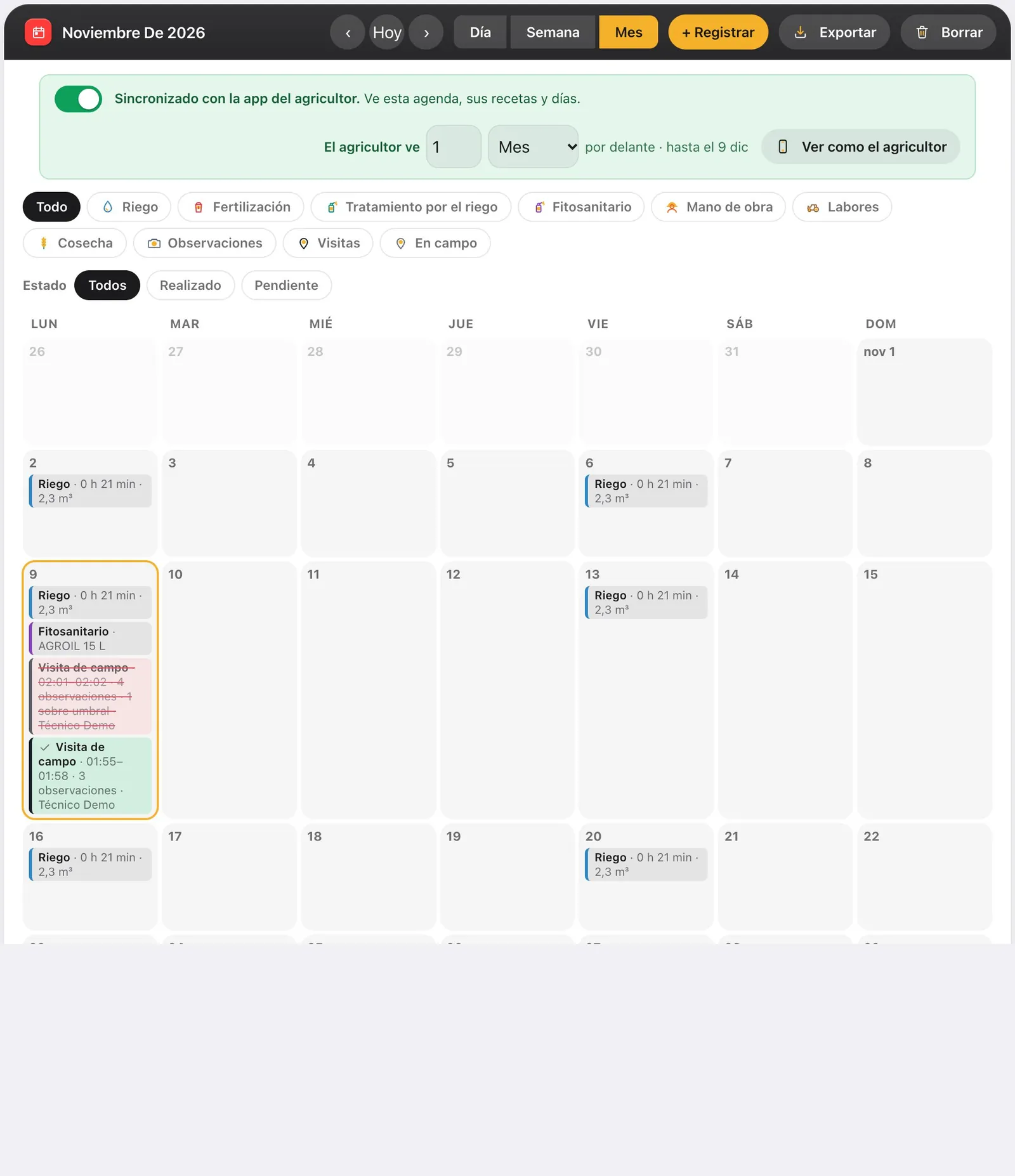
At the end of the period, from the holding’s Cuaderno tab you click «Imprimir cuaderno» (print logbook) and get the official farm logbook as a PDF, by holding or by crop. It is included in all plans, including the free one. We explain it step by step in how to get the official farm logbook as a PDF.
Please note that Orcelis does not yet submit the logbook directly to SIEX: it keeps the complete record and generates the official PDF, which is what you need to stay up to date and present it when asked.
Frequently asked questions
What is the digital farm logbook?
It is the electronic record of a farm holding’s operations: plant protection treatments, fertilisation, irrigation, field operations and harvests. In Spain it is called the «cuaderno digital de explotación agrícola» and it is governed by Royal Decree 1054/2022, within the SIEX system.
From when is the digital logbook mandatory in Spain?
It is phased in. Recording fertiliser applications is mandatory from 1 January 2026 and the fertilisation plan from 1 September 2026. Plant protection treatments must be recorded electronically from 1 January 2027, and the full digital logbook arrives on 1 January 2028 for holdings above the thresholds.
Which holdings will have to keep the full digital logbook in 2028?
Those exceeding any of these three thresholds: 30 ha of total area adding rainfed and irrigated land, 5 ha of irrigated land or 0.1 ha of greenhouse. Exceeding one is enough.
What happens if I don’t keep the logbook up to date?
Non-compliance can mean losing between 3% and 100% of your CAP payments. It is not a fixed fine: it is a percentage of your payments that depends on the severity and on whether it is repeated.
Can I keep using a paper logbook or Excel?
During 2026, fertiliser records are accepted on paper or in digital form. As the electronic phases come in, paper stops being valid. A spreadsheet does not, on its own, guarantee the official format or the traceability required.
Does Orcelis submit the logbook to SIEX?
Not yet. Orcelis keeps the complete logbook from each crop’s schedule and generates the official farm logbook as a PDF, included in all plans. Direct submission to SIEX is not available yet.
Who has to record the operations, the technician or the grower?
Responsibility lies with the holder of the farm, but in practice it is best recorded by whoever does the work. In Orcelis the technician prescribes and the grower confirms on their phone what they have applied, so the logbook reflects what really happened.