
The crop coefficient (Kc) is the number that converts reference evapotranspiration (ETo) into your crop’s water use: ETc = Kc × ETo. It changes over the crop cycle: it is low in the initial stage, rises during development, peaks in mid-season and falls in the late season. To adjust it, divide the cycle into stages, give each one its Kc and its length in days, and correct it for climate, ground cover and what you observe in the field.
Orcelis’s screens are in Spanish; button and menu names are shown as they appear in the app.
What the crop coefficient is
Reference evapotranspiration (ETo) is the water lost by a well-watered grass surface under the weather of a given day. It depends only on the weather: radiation, temperature, humidity and wind. The crop coefficient (Kc) captures everything that makes your crop different from that grass: its height, how much ground it covers, the resistance of its leaves and evaporation from the soil.
Multiplying the two gives you crop evapotranspiration (ETc), which is the water irrigation needs to replace, plus the system’s losses. Example: with an ETo of 6 mm/day and a Kc of 0.8, the crop uses 4.8 mm/day, that is, 48 m³/ha per day.
How Kc changes at each stage
The FAO method (Allen et al., 1998, FAO-56 publication) divides the cycle into four stages and describes Kc with three values: initial, mid-season and end.
| Stage | What happens | What Kc looks like |
|---|---|---|
| Initial | From sowing or bud break until the crop covers about 10% of the ground | Low (Kc ini); depends heavily on how often the soil is wetted |
| Crop development | Until the crop effectively covers the ground | Rises gradually from Kc ini to Kc mid |
| Mid-season | From full cover to the start of maturity | Maximum and stable (Kc mid) |
| Late season | From the start of maturity to harvest or senescence | Falls to Kc end; more or less depending on whether the crop is harvested fresh or dry |
In deciduous woody crops, the cycle starts at bud break and Kc drops with leaf fall. In evergreens, Kc varies less over the year and depends mainly on canopy size.
Single Kc and dual Kc
- Single Kc: one coefficient that combines crop transpiration and soil evaporation. It is the one used to plan irrigation and works in most cases.
- Dual Kc: separates the basal transpiration coefficient (Kcb) from the soil evaporation coefficient (Ke), so that Kc = Kcb + Ke. It is more accurate when a large area of soil is wetted and irrigation is very frequent, but it requires a daily calculation.
How to adjust Kc to your farm
- Adjust the length of the stages to your area. Tables give indicative lengths; sowing date, variety and climate lengthen or shorten them. Go by the actual phenology of your crop.
- Correct for climate. The FAO-56 table values correspond to a sub-humid climate with moderate wind. In dry, windy climates the mid-season Kc rises, and in humid, calm climates it falls; FAO-56 gives a formula to correct it.
- Correct for ground cover. In orchards and vineyards, a young tree or a small canopy at wide spacing uses less water than a mature planting that covers the ground. A cover crop between rows, on the other hand, increases water use.
- Adjust the initial Kc to the irrigation regime. With very frequent irrigations that wet a large area, soil evaporation rises and so does the initial Kc.
- Check against the field. Soil moisture probes, tensiometers, the condition of the crop and the yield tell you whether you are under- or over-irrigating. Adjust the Kc of the stage that doesn’t fit, not all of them at once.
If the crop is under water or salinity stress, its actual water use is lower than Kc × ETo. That is not corrected by lowering Kc, but with a stress coefficient (Ks) or, better still, by irrigating properly.
How to adjust Kc with Orcelis
In Orcelis, each crop starts with the stages and Kc values of its variety. To see them, open the crop record and go to Datos del cultivo › Riegos y fertilización › «Ver más» (Crop data › Irrigation and fertilisation › See more). In the Parámetros de cultivo (crop parameters) tab, the Etapas (stages) table has one row per stage with its name, its DÍAS (days) and its Kc, as well as the nutrient split.
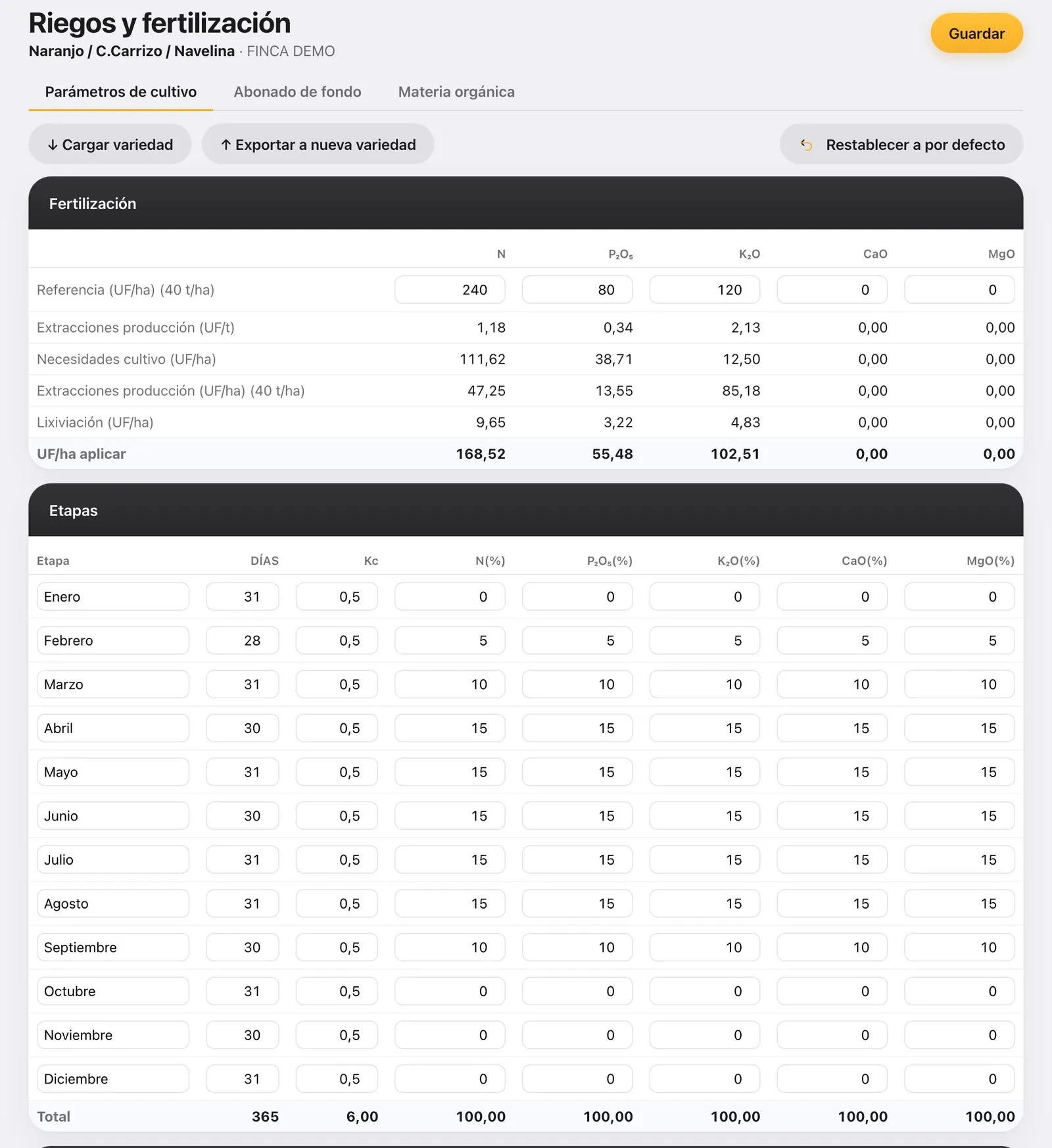
- Change a stage’s DÍAS to match the phenology in your area, or its Kc to correct it for climate or cover.
- The annual water forecast (Previsión anual, in m³/ha and total m³) is recalculated when you change the Kc values or the days, so you see the effect before saving.
- Click «Guardar» (Save). The change applies only to that crop.
- If you want to use those Kc values for other crops, click «↑ Exportar a nueva variedad» (export to new variety) and then load them with «↓ Cargar variedad» (load variety).
- To go back to the variety’s values, click «Restablecer a por defecto» (reset to default).
Remember that, in Orcelis, the water for woody crops also depends on the crop’s canopy and planting spacing. If the calculated irrigation doesn’t add up, check those two values first and then the Kc of the stage.
Frequently asked questions
Can Kc be greater than 1?
Yes. The reference is a short grass surface, and a tall, dense crop at full cover can transpire more than it does. That is why many field crops have a mid-season Kc slightly above 1.
Where can I find Kc values for my crop?
The most widely used reference is the tables in the FAO-56 publication (Allen et al., 1998), with values for the initial, mid-season and end stages of many crops. Irrigation advisory services and agricultural research centres often publish values adjusted to each region.
What is the difference between Kc and Ks?
Kc describes the water use of a healthy, well-watered crop. Ks is a stress coefficient, between 0 and 1, that reduces that water use when the crop is short of water or there is too much salt in the soil.